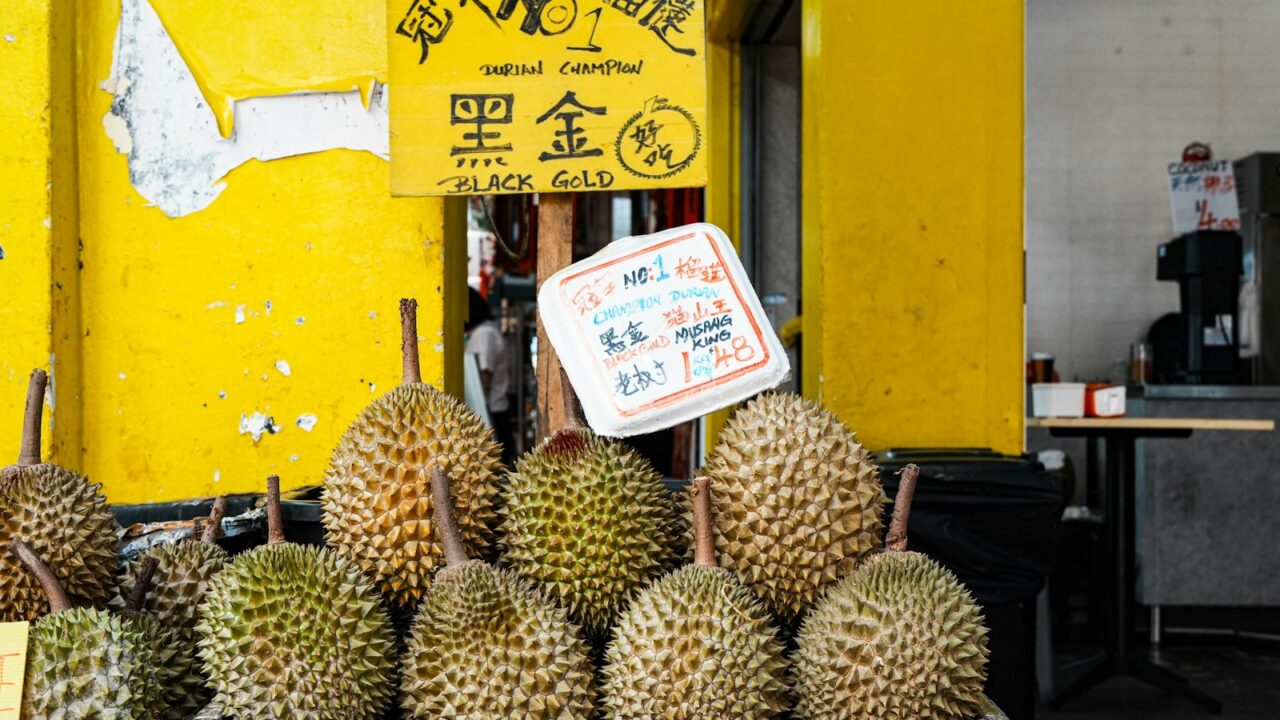
Scan a durian stall’s labels and you’ll eventually spot a mysterious code: D197. It looks technical, almost secretive — but there’s no mystery at all. D197 durian is Mao Shan Wang, the same celebrated fruit also known as Musang King. This guide explains what the D197 code actually is, why one durian carries three names, and how to use that knowledge to shop with confidence.
Once you understand the code system, those cryptic labels stop being confusing and start telling you exactly what you’re buying.
The short answer
D197 is the official cultivar registration code for Mao Shan Wang, also known as Musang King. All three labels — D197, Mao Shan Wang, and Musang King — refer to the same registered durian clone. If you see any of them, you’re looking at the same royalty of the durian world.
What the “D” code system is
Premium Malaysian durians are registered clones, each assigned a code in the form of the letter “D” followed by a number — Malaysia’s official system for registering durian cultivars through its agriculture authorities. The code is a precise, unambiguous identifier for a specific clone, in the same way a plant variety might be formally registered anywhere in the world.
Codes are accurate but forgettable, which is why the varieties that captured the public’s imagination also picked up catchy popular names. D197 is the textbook example: technically precise as a code, but far better known by its evocative nicknames.
Why one durian has three names
Here’s how D197 came to wear three hats:
- D197 — the formal cultivar code from the registration system. Precise, official, unmemorable.
- Mao Shan Wang — the Mandarin reading of characters meaning roughly “Cat Mountain King”. This is the name most Singaporeans use every day.
- Musang King — a name linked to the musang (civet) and a place, widely used in Malaysia and internationally.
Same clone, three doorways. The code is the anchor; the nicknames are how people actually talk about it.
Why Mao Shan Wang earns the crown
D197 didn’t become the most famous durian by accident. It is prized for a distinctive combination of qualities:
- Flavour: thick, bittersweet and complex, with a lingering finish that connoisseurs chase.
- Texture: dense, sticky and creamy rather than watery.
- Colour: typically a rich, deep yellow to golden flesh.
- Character: that signature balance of sweet and bitter that sets it apart from milder varieties.
This intensity is exactly why Mao Shan Wang commands premium interest — and why so many first-timers use it as the benchmark for what durian should taste like.
Using the code to shop smarter
Knowing that D197 equals Mao Shan Wang equals Musang King protects you at the stall. A few practical tips:
- Treat D197, Mao Shan Wang and Musang King as interchangeable — they’re the same variety.
- Don’t confuse grade words with the variety. Terms like “premium”, “reserve” or “grade A” describe a seller’s quality tier, not a different durian. A “premium D197” is still D197.
- Remember that “old tree” or “black gold” style Mao Shan Wang is still D197 at its core — just a particular selection or grade of it.
With the code decoded, you can focus on what actually matters: freshness, grade and flavour on the day.
D197 among the other durian codes
D197 doesn’t exist in isolation — it sits within a whole family of registered durian codes, and knowing a few of the neighbours helps put its fame in context. D24, for instance, is another hugely popular code, often sold in a wine-like “XO” style. Codes like D101 and others each identify their own clones with their own characters. What makes D197 stand out isn’t its number but its eating quality: that thick, bittersweet, complex flesh which turned a plain code into the most recognised name in durian.
It’s worth repeating that the number itself carries no ranking. D197 isn’t “better” than D24 because of its digits — it earned its crown through flavour and popularity, not its place in the sequence. Treat every code as a neutral identifier, then judge the durian on how it actually tastes.
Taste D197 for yourself
Reading about Mao Shan Wang is one thing; tasting it is another. Our Mao Shan Wang box is the direct way to experience D197, with an old-tree selection for those chasing extra depth. Compare it against the wider field in our durian varieties guide, and get the full backstory in What’s in a Name: Mao Shan Wang. Whichever you choose, our Singapore durian delivery service brings it fresh and dehusked to your door.
Frequently asked questions
Is D197 the same as Mao Shan Wang?
Yes. D197 is the official cultivar registration code for Mao Shan Wang, which is also known as Musang King. All three names refer to the same registered durian clone.
What does the “D” in D197 stand for?
The “D” marks a registered durian cultivar in Malaysia’s official coding system, followed by a number that identifies the specific clone. D197 is simply the code assigned to Mao Shan Wang.
Are Musang King and Mao Shan Wang different durians?
No. They are two popular names for the same clone, D197 — Mao Shan Wang being the Mandarin reading and Musang King the name linked to the civet and a place.
Is “premium” D197 a different variety?
No. Words like premium, reserve or grade A describe a seller’s quality grading, not a separate variety. A premium D197 is still Mao Shan Wang.
Ready to meet the King of Fruits by any of its names? Message us on WhatsApp for today’s seasonal price and we’ll deliver a fresh, dehusked box of D197 islandwide — start at our durian delivery page.